
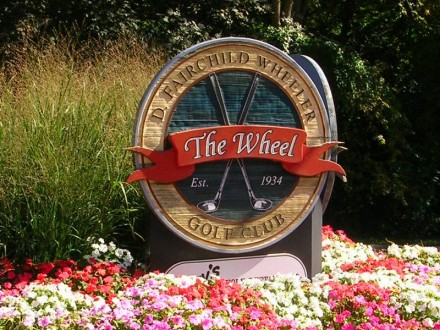
Update: Public hearing June 1. A special meeting of the City Council’s Contracts Committee will take place Wednesday 7 p.m. in the Democratic Caucus Room of City Hall regarding the proposed sale of four acres of “excess” Fairchild Wheeler golf course property to Sacred Heart University. Under the proposal the city will receive $4 million and the property must remain in a natural state for perpetuity and cannot be developed. A public hearing on the proposal will take place June 1, 5:30 p.m. at Geraldine Johnson School cafeteria, 475 Lexington Avenue.
City officials say Sacred Heart wants the park property that abuts its campus for land coverage purposes to satisfy zoning regulations to allow the school to continue its major growth on campus proper in Fairfield. Fairchild Wheeler is owned by the city but located in the Town of Fairfield.
Jack Banta and Jeanette Herron are co-chairs of Contracts.
Although SHU campus proper is located in Fairfield, it has dormitories and an extended scholastic presence across the town line into Bridgeport. Its growth has created public safety concerns in the city including some students partying in the North End. SHU critics assert the university has taken an elitist attitude toward the city and has not been a good neighbor.
Mayor Joe Ganim’s Chief of Staff Danny Roach calls the proposal a “great deal” for the city. Taxpayers receive $4 million and the wooded-wet land cannot be touched. The sale would have no impact on the golfing community.
One city councilor who represents the North End, AmyMarie Vizzo-Paniccia issued a blistering attack of the proposed sale, in a letter to her council peers.
I will not be in town tomorrow and unable to attend this rushed meeting regarding the open park land in my district. For my comment–I AM TOTALLY OPPOSED TO THIS city asset being sold and abused by our Fairfield tax-exempt and disorderly conduct type neighbors and in general not losing this to SHU as this is a totally liability to us.
I’ve gotten many calls from those just hearing about this and they are not happy at all. This is also a sketchy deal as it’s been hush hush to many and open to the select few working behind the scenes.
I was sent an email last week asking to meet about this, but when I answered with questions, I never got any responses back. (Makes you have to wonder???) This is another way for SHU and Fairfield to grow on us yet talk bad about Bpt, not contribute and hold our residents hostage.
Please, please, please do not pass this at all–not for me, But for the future of Bpt, open land for our youth, seniors and veterans–our residents of all ages. This is like those medicine type commercials. They show pretty pictures, yet the words are toxic. Close your eyes and listen to the words, NOT the advertising pictures and read the small print!
Do you know SHU also has more plans in the works for more Bpt property? Yet!!! Bpt is fully liable$$$ and the losing entity.
I hope you do consider this very long term situation and vote against this. This meaning the golf course and 90 acres and the golf course. By the way, the original was 4 million dollars for
just some golf course property. Now they come back saying 4m? No problem, give us more land but you are not getting more money! And no matter how much money offered, I will still vote “NO.”We should not sell our assets, our open land, our history, our city, our home. Signed,
AmyMarie Vizzo-Paniccia
Councilwoman, 134th District.
203-275-6412P.S. This will not fill any gaps as that budget vote widened what ever was there.

Amy’s scorching letter to the powers that be is a sign there is genuine representation for constituents in some parts of the City and to the extent you can tie that representation to what is good for all in the City, it becomes a hot issue.
No more land is being made, so if you sell it you exchange a hard asset for some cash, and if your balance sheet shows more debt than asset value, well you end up with no land and lesser debt. Perhaps someone can get poetic about that?
“I think that I shall never see,
a thing as lovely as a lien (removed?)”
or
“The grass is always greener in Fairfield’s yard,
But we own it and can sell it, it’s not that hard.
Sell it for some “green,” and reduce the debt that’s red,
Don’t be bothered by the people, soon they’ll be in bed!”
Possibly we may yet have a meeting where all sides get to speak AND LISTEN as well? What a concept. Worth a try? Time will tell.
John–you seem to miss the idea cities are not in the hard asset owning/wealth building business. Cities are in the property taxing business. City-owned land is a liability. As long as the land stays the way it is, there would be no difference between BPT owning it and SHU. If SHU assumes responsibility for the upkeep and liability it is advantageous for SHU to own it. Either way the land produces no revenue. SHU would have to maintain it and if someone got hurt on the land it would be SHU’s problem. City, state and federally owned land always represent a cost and liability (through upkeep, maintenance or lost taxation) to the people. Why are these eight acres different than eight acres under Rem-Grit, downtown abandoned buildings or on Steel Point? Should the city keep all the land it owns under the idea no more land is being made? The city could ultimately own the entire city. But then, who would pay the taxes?
Take the entire golf course. Say nothing about usage changed and it was privately owned. Would the property tax revenue from the course be more than the city generated income? Even if it were not, the tax revenue would be a constant and the income generated is a variable.
BOE SPY,
I have written more than the statement above yours on this topic earlier. I referenced an idea, if instead of exchanging/selling the land we might look at allowing the use of the land for a regular fee with liability and maintenance paid by the Lessee. I also asked about the price, comparables, and value of the acreage to SHU that might make this negotiation more valuable for us as a revenue item annually. If SHU needs this land to make a case for a larger usage of their existing property in Fairfield, then there is such leverage and its value can be determined and shared.
Concept: property with no value changes into property with very specific application to SHU in Fairfield development plans for which they would make annual revenue payments to Bridgeport, perhaps increasing, or revisited depending on other factors like discount rates, etc. A flow of revenue is what we pursue with taxation, isn’t it? And this flow comes from development by a non-taxpayer, so it could be a breakthrough concept. Do we trust City officials with lump sums of money? I for one feel they give us no reason to do so. Does the public have any memory of how lump sums of money get spent? For instance, who can recite the active City projects that were developed in the past year, with how much funding, from what source, and current stage of completion? Rest my case. Time will tell.
So you would trust the city to monitor and adjust a yearly fee but not with a lump sum? Cities make very poor business people. What city rental agreement is ever market value? Did the city get ‘market value’ when they rented Seaside to the Vibes or did the city get screwed on that deal (PD OT)? Just sell it and move on or the next thing you know BPT needs a Director of land management and staff to ‘manage’ the lease.
The less politicians are involved the better it is for the taxpayer.
There is another problem. By leasing the land to SHU it is no longer ‘for public use.’ Fairfield could then take the land back. They could still take it back but now it belongs to SHU, so who cares?
Well said, AmyMarie. History has taught us, or should have taught us, anything involving SHU can only be a bad deal for Bridgeport.
In that vein, to quote from Lennie’s presentation of the meeting details/background, above.
“… Under the proposal the city will receive $4 million and the property must remain in a natural state for perpetuity and cannot be developed …” Sure, “cannot be developed.” Just like the large building on Madison and Eckart Street that was built via a special spot-zoning agreement with the neighborhood and the Bridgeport PZC would only be used as a low-impact, day-operated, medical office facility. Of course, as everyone now knows, this was an outrageous lie connived by SHU to create more dormitory space in Bridgeport. Within days of this deceitful pact between the city and neighborhood being sealed and voted on by the PZC, the neighborhood learned, to their chagrin, they had been duped by the city and SHU and there was to be a new, major dormitory in their Residential-A neighborhood. WE HAVE TO REALIZE IF SHU GETS CONTROL OF THIS WOODED PARKLAND, IT WILL BE BUILT ON EVEN AS THE ADJACENT CAMPUS EXPANSION IT ALLOWS FORCES A GREATER INTRUSION ACROSS PARK AVENUE INTO BRIDGEPORT.
Bottom line: It is insane for Bridgeport to do anything that furthers the growth of SHU. It can only mean a further, destructive intrusion into Bridgeport that will cost Bridgeport taxpayers many millions of dollars in lost tax base and increased provision of FREE city services to SHU.
THIS DEAL IS CROOKED AND STINKS TO HIGH HEAVEN. The $4 million in blood money from SHU will cost the city many millions in “interest” in the years and decades to come. Any council members who vote for this deal should be targeted for defeat in NEXT YEAR’S city council elections.
*** Council Weighs in, my “Derby!” It’s a $4 million done deal should you pay half now to show commitment on SHU’s part and the other half once they have the deed in their hand, no? ***
I wonder how much of the BPT PD OT budget is spent addressing the obnoxious presence of the spoiled-brat SHU partiers on THU, FRI, SAT and SUN nights from mid-August until Jun (?).
I wonder how much Bridgeport violent crime and homicides are due to the stressing of our police resources because of the disruptive SHU presence in our neighborhoods (?).
Very little, the fines and charges collected from the spoiled-brat SHU partiers easily outstrips the cost. The great thing about the spoiled-brat SHU partiers, they pay their debt to society in cash.
Thank you, Danny Roach and SHU for the new rooftop tennis courts and dormitory!
Hey! You can see all of Long Island Sound from up here! Luv 30!
www .youtube.com/watch?v=JpV6WULqLTw
Based on what the public has been provided, the sale of the golf coarse acreage has no impact on Bridgeport residents. It will allow SHU to build more on their existing campus in ‘suburban Fairfield Connecticut.’ Proceeds from the sale, by Charter, go into the Parks capital fund.
Allowing SHU to install tennis courts for their use has more of an impact on Bridgeport.
The golf course is in Fairfield, not the 134th council district.
The Parks Board supposedly voted to “waive” the money going to the Park Capital Improvement Fund, something they have no power to do. One more reason to vote against this deal.
Can the public attend this meeting in the caucus room? Is that the room in the very rear of the building, behind the Council chambers?
… and what good could it do …
This is getting to be like Caddy Shack. A Mole-In-One! We don’t need to hit another Mulligan like we did with Little League in 1989.
Correction, 1987. 1989 was when Trumbull rolled through Bristol to win it all!
Hey Grin. You are making me laugh. What are you talking about?
What does a regional Little League facility have to do with a private tennis court for SHU students?
What is this? A belated Valentines Day present?
Say it with Flowers!
What is the rush here?
Makes me think something isn’t right here. And I am sure it has to do with budget matters.
And why is a Public Hearing on the sale of public property taking place at Geraldine Johnson School?
Slam the brakes on and slow this process down.
If for some reason the hearing can’t be held at City Hall, why not have it at a school in the 134th?
The public hearing should be held at SHU-impact ground-zero, John Winthrop school. That site will also serve as a reminder for elected officials on the wrong side of this issue they will have to account for their actions (or inaction) in the future.