
Renters rallied in Hartford on Tuesday in favor of eviction reform and lawmakers who spoke at the gathering talked about their new strategy for trying to pass a law to largely end no-fault evictions — ask the Senate to take it up first.
In past sessions, the bill has gone first to the House and hasn’t been called for a floor vote. So lawmakers said they will route it through the Senate first this year. No-fault or lapse-of-time evictions typically occur at the end of the lease, and tenants argued at the rally that these types of evictions are often retaliatory or discriminatory.
“Too many people believe eviction is a personal failure, instead of what it really is: a policy failure,” said Sun Queen, a New Haven tenant and activist. “Eviction is not an individual problem. It is a structural one. It is what happens when housing is treated like stock portfolios instead of human survival.”
This type of protection already exists for people with disabilities and seniors in Connecticut. Tenant advocates want to see it expanded to include a larger population.
Landlords and Republican lawmakers have argued against this change, saying it violates landlords’ property rights. At a press briefing earlier this year, members of the Connecticut Apartment Association, which represents landlords, said they use no-fault evictions to get rid of problem tenants who do things like make too much noise or smoke in non-smoking areas.
“The end of the lease is a time when both parties can say, ‘hey, I want to stay,’ or ‘hey, I want to go,’” said Lauren Tagliatela, a Connecticut landlord and member of the apartment association. “We use lapse of time very judiciously and very rarely, but it is an important tool to have.”
Housing Committee co-Chair Rep. Antonio Felipe, D-Bridgeport, said the proposal is a key part of ensuring affordability for renters. Many tenants have said that new landlords will buy buildings and push tenants out en mass so they can raise the rent.
“All I’m going to say is, if you can’t see the correlation between this and affordability, open your eyes,” Felipe said. “If you can’t see the fact that we have a rising homeless population along with the rise of rent, open your eyes.”
Homelessness has been increasing for the past few years in Connecticut. From January 2024 to January 2025, homelessness rose by about 10% statewide, according to an annual census of the population.
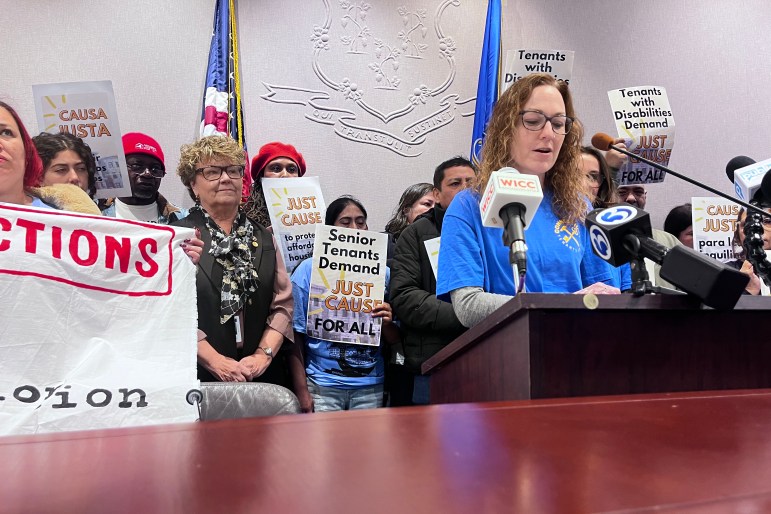
Housing Committee co-Chair Sen. Martha Marx said she won’t leave the committee until this bill passes.
“The eviction laws that we have in Connecticut right now are nefarious, and we need to make sure that everybody in our legislature — all those that vote against it — that everybody in their community knows what they voted against, because this is an election year,” Marx said.
Stephanie McHugh, a New London tenant union member, said out-of-state landlords especially are buying up properties and raising rents or evicting existing tenants.
Wilfredo Parra Aguilar, a Hartford tenant, said at Tuesday’s rally that no-fault evictions are also used to retaliate against renters who complain about “deplorable conditions,” as well as to discriminate against tenants based on immigration status.
“Unfortunately, it is not possible to count how many immigrant families are evicted without a cause, because many times we’re forced to leave early to avoid conflict or retaliation,” said Parra Aguilar, speaking through a translator. “There are families today who share a couch or a single room to keep moving forward and not end up sleeping on the streets.”
This article first appeared on CT Mirror and is republished here under a Creative Commons Attribution-NoDerivatives 4.0 International License.

Where does a citizen of Bridgeport look to get information on housing options including rentals? Ihave pursued City officials for numerous years to deal with their elimination of Fair Housing Commission and Fair Rent Commissions to be staffed by qualified citizens and offer a regular location to ask for help and be assured to receive such.
I continue the struggle once again at City Council last evening. Oversight to assure that each official signs the “residency reporting” form in the Town Clerk’s office annually. It is an Ordinance for officialdom. Mayor Ganim has not signed it thus far this year. Where is an official in his office who can do OVERSIGHT and actually remind him of this responsibility? I offer my City Council comments from last evening:
Comments to City Council February 17, 2026
Welcome to each member of the CC tonight. It is the final public speaking session in a short month. Oversight is a responsibility of all. You are expected to oversee on behalf of all the public. Specifically, you created an ordinance several years ago that requires official residency reporting by “Elected Officials, Board and Commission Members in the City of Bridgeport.” The Ordinance requires annual reporting during January or when changes occur subsequently in a year.
Are you aware of this duty? Why have eleven of you failed to sign as of this morning? Why have only two members of the Board of Education signed, thus far, when one of them is contesting that his address is private and not disclosing it? Both Registrars of Voters have signed in as well as Town and City Clerks and the Library Board supported reporting by seven of their nine members. No other Board or Commission member appointed per Charter or Ordinance has yet signed in. Which of your Sub-Committees will take responsibility for the task to inform all officials, reviewing regularly, and reporting to the public? Is it likely that you will assign the obligation to Miscellaneous Matters?
Ask a question about housing in the City. Can you get a helpful answer? For instance, of the approximately 150,000 folks who lay their head at rest each night, how many own their residence? Do the majority rent their location, or have no permanent residence, as in unhoused or homeless; in a healthcare facility, a half-way house, or student housing; or jail, or Air BnB? Do you know how many folks in each category and where they go for service from the City now and in the future? Where are the citizens to serve on Boards and Commissions and learn about housing choices for the future? Where do we look for knowledgeable and experienced citizens to represent the issues and concerns that are regional or Statewide?
The next meeting of Casual Civics Conversations will be held on Saturday at 8AM at Wood’s End Deli. Perhaps HOUSING as a topic? Time will tell.
“All I’m going to say is, if you can’t see the correlation between this and affordability, open your eyes,” Felipe said. “If you can’t see the fact that we have a rising homeless population along with the rise of rent, open your eyes.” – That quote is a slogan, not an argument. “Open your eyes” is what people say when they don’t have numbers that actually connect (a) banning no-fault nonrenewals to (b) lower rents and (c) lower homelessness. He’s confusing correlation with causation—twice.
Yes, rents have been high and homelessness rose. But simply observing two bad trends at the same time does not prove (or even strongly suggest) that the policy lever he’s pushing will fix either one. CT’s own homeless-system leaders describe the main pressure as inflow exceeding capacity and, more directly, not enough permanent housing—that’s a supply/placement problem, not a “lease renewal” problem.
Even if rent increases contribute to homelessness, “ending no-fault evictions” doesn’t make rent cheaper.
Affordability is mostly about how many units exist vs. how many households need them, plus income and subsidies. A nonrenewal ban doesn’t add a single unit. At best it changes who gets to stay in existing units; at worst it raises the risk and cost of being a landlord, which gets priced back into rent (risk premium) and tighter screening. Policy researchers flag exactly these tradeoffs with “good cause” rules: more screening barriers, potential supply shifts, and legal/administrative friction.
His “rising rent” premise is sloppy even on its own terms.
Rents are uneven—by region and by time. Connecticut saw periods where average asking rents fell (Zillow-tracked listings showed a notable statewide dip in May 2025 versus the prior month and year). And Zillow’s own CT summary has shown recent softness rather than a clean, monotonic “rise.” So the “rents are rising, therefore this bill is the solution” move is logically weak and empirically cherry-pickable.
He’s implying the bill solves homelessness without addressing what homelessness data actually shows.
Connecticut’s point in time count did rise from 3,410 (Jan 2024) to 3,735 (Jan 2025)—about 10%. But the reporting around that increase emphasizes system capacity, shelter/permanent housing bottlenecks, and prevention resources, not “no-fault evictions” as the dominant driver. If he wants to claim the bill will reduce homelessness, he needs evidence that (a) no-fault nonrenewals are a major share of entries into homelessness and (b) restricting them meaningfully reduces entries without offsetting harms (like stricter screening). He offered none.
There’s a glaring omitted downside: the bill can shift harm onto new renters and marginal applicants.
When you make it harder to end a tenancy at lease-end, landlords compensate up front: fewer “maybes,” more income/credit hurdles, more reluctance to rent to anyone with imperfect history. That can push the most fragile households into fewer options—exactly the opposite of what you want if you’re worried about homelessness.
If Rep. Felipe wants to make that claim credibly, the standard isn’t “open your eyes.” The standard is: show data that no-fault nonrenewals are a meaningful pipeline into homelessness in CT, and show that this reform reduces that pipeline more than alternatives like rapid rental assistance, eviction diversion/mediation, and—most importantly—adding/accelerating housing supply and permanent supportive housing placements, which even CT homelessness leaders emphasize.