
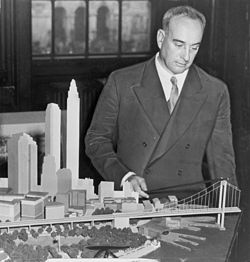
Robert Moses was born in New Haven in 1888 to German-Jewish parents, the early years of his life in the shadows of Yale University. But he made his mark driving New York politicians nuts as the preeminent urban planner of New York and the masses he impacted, including any self-respecting Bridgeporter who must still navigate the highway systems he created.
If you haven’t read it, The Power Broker by Robert Caro.
The thing about my life? I am privileged to chronicle the lives of extraordinary entrepreneurs including the late communications executive Robert Price, an iconic Republican political consultant who served as deputy mayor to New York City Mayor John Lindsay in the 1960s. Before David Garth, before Lee Atwater, before Karl Rove, and anyone else you want to include as elite campaign operatives, there was Price, the most sweet and sour personality you’d ever meet.
The late Jack McGregor, founder of the Pittsburgh Penguins and Bridgeport Bluefish, introduced me to Price.
For three years I commuted to Price’s home in the Upper East Side of Manhattan kissing Central Park. The aged Price loved chocolate shakes, almost as much as he loved making money. “Making money makes me happy,” he’d tell me, lounging in his pajamas, as I peered over his desk.
Little things mean a lot. The guy was a craggy-faced billionaire, yet the look of cherub contentment on his face sipping that Dairy Queen shake through a straw seemed biblical. Price passed away in 2016.
What follows is a chapter about the cunning Moses butting heads with Lindsay and Price.
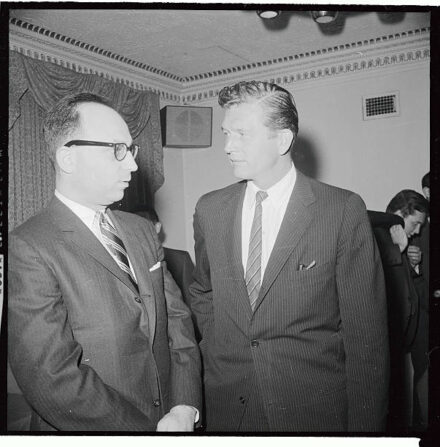
Robert Price, John Lindsay circa 1966
March 1966, location: the 21 Club, the landmark gathering spot at 21 West 52nd Street, where the low heeled, high heeled and well heeled cut more deals than the very New York Stock Exchange that was on the mind of Robert Moses, chairman of the Triborough Bridge and Tunnel Authority.
The job title was actually a disservice to the master borough builder whose enemies had compared his persona and methods to Italian fascist Benito Mussolini and Russian communist Joseph Stalin.
In late 1965 Mayor-elect John Lindsay had a sit-down at the Hotel Roosevelt with Moses, a controversial figure representative of what Lindsay felt was wrong with the city. Lindsay wanted to replace Moses, who had been the face of public works in New York City and New York State for decades.
That first meeting did not go well.
“If you elect a matinee-idol mayor, you’re going to get a musical comedy administration,” Moses reportedly said to aides afterwards.
This time Lindsay brought Machiavelli, Adolf, The Monster to the table. If the meeting did not go well the mayor had a witness he could count on, and someone, albeit a precocious 33-year-old deputy mayor Robert Price, who would not back down from a man used to getting his way. Price relished these moments: the strategy, the cold-blooded negotiation and the power of persuasion. Price hated losing, even to a man he admired, and no doubt Price thought much of Moses, the legend, even if he knew little more about him than his survival skills in a cannibalistic political world. Price admired Eisenhower. He admired Moses. Ask him for another name on that level in his short life and he’d growl before he provided an answer. Price was not a man easily awed.
Lindsay and Price arrived separately in their chauffeured cars, as did Moses. They sat up front, close to the door, three of the most high-profile men in Manhattan. What was the point of going to the 21 Club if you couldn’t be seen? Moses had a lot on his mind including reviving his torpedoed Lower Manhattan Expressway plans that would’ve gutted parts of West Village and SoHo and displaced 2000 families. Moses’ development ideas through the decades had relocated nearly as many folks as had voted for Lindsay. The mayor wasn’t crazy about Moses messing with his constituents so early in his mayoralty. The New York Stock Exchange? Let’s get it the hell out of there, it’s too hard to get there, according to Moses. Tinker here, move this, build that. Welcome to the world of Moses.
Lindsay and Price weren’t biting. They tried reasoning with the man who could move mountains. They were already dealing with plenty of stuff. Not so fast, okay? The old man wasn’t happy. Price was less than half Moses’ 77 years and Lindsay, that matinee mayor, he looked good and sounded good, but where’s the substance? That, at least, was the way Moses saw it.
Within minutes the meeting was over. Moses removed himself from his seat and walked out the door. Price and Lindsay sat there for a few minutes when Lindsay said “We ought to get out of here.” They walked outside to slip into their vehicles, except there were no vehicles. What gives? they asked the doorman.
“Mr. Moses told the drivers that you wouldn’t be needing them, that they could leave.”
Moses, that sonuvabitch. Maybe the old man couldn’t throw a fastball like the old days but he could still break off a curve. Not that Lindsay and Price should have felt alone. The line of public officials mugged by Moses traversed down the block, around the corner, up into an alley where the victims were dispatched with proverbial blueprints, drafting tools and political chicanery that would make Machiavelli proud.
Moses was born in New Haven, Connecticut in 1888 to German-Jewish parents, the first years of his life in the shadows of Yale University. Moses’ father, a department-store owner and real estate speculator, moved the family to Manhattan in 1897. Moses had graduated from Yale University and earned a Ph.D in political science from Columbia University. Thousands protested in his day. Hundreds of thousands were dislocated. But surely the value of such a man who got things done cannot be ignored, and indeed needs to be celebrated for its greatness in building the city and state.
The bank robber Willie Sutton was once asked why he robbed banks. “That’s where the money is,” he replied. Sutton, a petty crook, thought small. Robert Moses, a personally honest man, thought large. Both wanted money. Robert Moses was not interested in money for himself. He wanted to build things. To do that you needed money, money to pay to build things, to build bridges and highways to move people, parks for recreation and new homes to clear slums. He could redefine society. To do that he needed power. Make that money and power.
Over a period of 20 years, Robert Moses gradually unlocked the safe protecting money and power in New York State and New York City. For security and safety reasons, the people, otherwise known as citizens, theoretically divided power into a multiple-chamber safe. If something went wrong in one part, the rest was protected. This was the theory, at any rate.
By 1946, it was a rare project that Moses supported that did not get built, and build pretty much as he wanted. He was to be the overlord of public works in New York for another two decades. Moses was never elected to public office. As he accumulated power, it was rare for a governor, a mayor, a legislator, a banker, a citizen, an anything to be able to stop him. At first, few wanted to stop him. Then they found they couldn’t.
The people? The people be damned.
Robert Moses started his public life as a progressive, part of a movement to modernize American political systems and improve public life. Progressives tended to be idealistic souls. Critics felt they were not very much in touch with the “practical” ends of politics, except in revulsion of it. Regular politicians derided progressives as impractical “goo-goos,” conjuring up an image of drooling babies whining. A goo-goo was short for “good government.”
Democrat Al Smith was definitely not a goo-goo. He was a practical Tammany pol, made a bit unusual for his honesty and support of some progressive ideas. Smith was elected for governor in 1918 promising to modernize state government. His progressive friends suggested Moses lead the effort. Moses and allies served New York City Mayor John Purroy Mitchel after his election as a reformer in 1913. They were supposed to rewrite civil service regulations on hiring to make them work again after being gutted by Tammany supporters. Smith had a role in the gut. The reformers failed and were tossed out of office in 1917.
Despite the history, Smith hired Moses. The decision was rewarded. Moses and staff wrote or rewrote existing criticism of New York government, and added their own substantial touches. Smith pushed it through the legislature. Moses, who was not a lawyer, gained a reputation for incredible knowledge of New York law, which was found to be essential in the success for the project. The project won national praise as a model for state governments across the United States to modernize. Smith in gratitude asked Moses if there was anything he could do for him. Moses, who was intensely interested in open space, suggested a park proposal to add recreational opportunities for New York City and the state. The thoroughness of the proposal won national praise.
The praise surprised Smith. By now confident in an aide who helped him rewrite the state constitution, the governor gave the project full support. And after all, it would help all those poor people from the city – and Smith had grown up as one of them. New York City was virtually landlocked for large park opportunities. Not so for rural Long Island to the east of the city. A huge complex of parks and amenities, roadways to parks and other support projects were proposed. Moses provided the proposals and plans. Smith provided the power and money by breaking arms in the legislature.
The Long Island projects provided a bonanza of publicity, opening up clean beaches and picnic areas for recreation-starved New Yorkers, but similar projects throughout the state also earned praise, an unusual phenomenon in a state split between its urban and rural parts. The project was a home run. Smith took full advantage to use his administration of New York as a model to run for president in 1928 as a Democrat. Someone had to run the state while he was busy. He left Moses in charge. Observers said Smith treated Moses as a son. The feeling was mutual. The progressive bureaucrat had studied the methods of the practical politician. The theories of government were meeting the realities of human nature.
This was the first click of the tumbler to unlock power by Moses. Franklin Delano Roosevelt succeeded Smith as governor in the 1928 election. An aficionado of power himself, FDR sought to successfully reel in Moses. But following Smith’s loss for president, Roosevelt was dreaming of a challenge himself.
Moses’ park and roadway improvements were enormously popular in the state and studied around the nation, so FDR let Moses be more or less, allowing his administration to reflect in their success. The Great Depression led to the bankruptcy of New York City and new calls to throw the rascals from Tammany Hall out. Fiorello LaGuardia, a reformer who despised Tammany, was elected in 1933. But the city was broke. Unemployment was huge. Moses even took a crack at running for governor as a Republican in 1934 but was croaked by incumbent Democrat Herbert Lehman. Nevertheless, one of the few men with a track record of success in running government programs was Robert Moses. Perhaps Moses would like to take a crack in New York City? He would and did.
As director of parks, Moses immediately moved to clean up and expand existing facilities and build new ones. Moses imported his planners from New York State to help design the projects. Federal programs to help unemployment with public works were passed by the Roosevelt administration. The problem around the nation was plans to spend the money. Not in New York. Not with Robert Moses. He worked designers, architects and engineers without end to come up with plans, to get the funding. A proposed bridge complex connecting Queens with Manhattan and the Bronx had stalled, mired in incompetence. LaGuardia passed that one along to Moses. He built it.
The tolls from the Triborough Bridge complex provided the basis of a Moses empire. The success of the project was wildly beyond projections, leaving the developer with huge amounts of cash in excess of the bonds to pay for the project. Rather than pay off the bonds and dismiss the authority that built the bridge, Moses had a bill quietly pushed through the Legislature allowing the refinancing of Triborough debt at will. The bill also expanded the scope of the authority’s duties beyond bridges over the East River to include other minor stuff. This bill theoretically expanded the life of the authority forever. The redefinition of Triborough let Moses build pretty much what he pleased.
Now Moses had his own bucket of money when he talked to the federal government, the state government, or the city. The public was chipping in every time they paid a toll on one of the bridges or roads.
This was a second click of the tumbler.
The third click and access to all the power he needed to get all the money he needed was not long in coming.
Fiorello LaGuardia provided the reform he promised as mayor. By 1945, New Yorkers had enough. Tammany came cooing again, but this time with a twist. They would let Moses control all public-works construction so everyone knew it was honest. In addition to building public works, Moses had gained a reputation for building them well, building them honestly, and generally they were within budget. Moses said he could support that, and it was done. That was it. If Moses backed it, it was a go.
A new home for the United Nations? Moses put the parties together. The Bronx-Whitestone, the Henry Hudson, the Verrazano, the Throgs Neck, all Moses-influenced bridge projects. New bridges, highways, new housing – you name it. The public works were built honestly. Tammany got its money through handling legal business and fees that skimmed from the project, but did not affect the project itself. It was all legal, in a roundabout way.
On the state level, park and parkway development continued. Moses was in charge of a staggering project to harness the Niagara River for hydroelectric power, and create a huge park at the same time. The works were good. The works were needed. The works were well done. The builder was lavishly praised. When someone tried to slow him down the naysayer was just as likely to be run over by public opinion in the press as by Moses himself. Projects were going up. The politicians were happy. Business people were happy. Red tape was being cut. The unions were happy, they had construction jobs for their members. Everyone was eating.
At one time, Moses held a dozen different positions in state and city government. It all seemed too good to last. It was. By the middle 1950s, criticisms started to build. Moses seemed oblivious to criticism. His stubbornness was particularly evident in the city. No matter what was built was probably going to affect people. Their opinions were the least of his concerns.
In his Pulitzer-Prize winning biography “The Power Broker: Robert Moses and the Fall of New York,” author Robert A. Caro laid out the case pro and con for Moses. The proposed Cross-Bronx Expressway would cut across seven miles of a densely populated area of the Bronx. Builders had to confront hills, valleys, rock, constructing tunnel and overpasses. All the while, the trains, roads, water, sewage, natural gas, electric, and anything else, could not be disrupted. The builder-surgeon was operating on a patient who must remain awake at all times. It was done. It was a tremendous accomplishment.
Caro then turns coldly to the impact on people. The dislocations, the destruction of neighborhoods, how it hurt people. Even modest attempts to modify the project were dismissed by Moses. The people were rebuffed. Politicians who attempted to modify plans were rebuffed. If a figure pushed too hard, some pet project might become “unfunded.” If a mayor or governor pushed too hard, there might be a leak that Moses was considering his resignation. For years, the ploy worked. The system was cowed, but it was backing up. Newspapers found some slice of corruption in the assemblage of parcels for housing projects. The dislocations began to attract attention and opposition.
A housewife from Greenwich Village wrote a small book in opposition to the kinds of projects enthusiastically supported by Moses such as the Lower Manhattan Expressway as being more harmful than helpful to cities. As Thomas Payne’s “Common Sense” inspired the American revolutionaries, Jane Jacobs, in her “The Death and Life of Great American Cities” in 1961 inspired city residents to fight against Moses. In one chapter Jacobs observed the street life on her one little block, the apartments, the stores, the bar, a small factory, kids playing on narrow sidewalks. In contradiction to most theories of American planning at the time, Jacobs celebrated everything they found wanting: the crowded streets, the lack of space and the mixture of uses.
She was dismissed as a crank without academic credentials. She may not have had the credentials but her neighbors thought she was right. Attempts to build cross-town expressways in Manhattan from the Hudson to the East River were snarled and eventually killed. Over the decades the book became a classic. Moses ran into trouble with a new governor, Nelson Rockefeller. This eventually led to another threat of resignation by Moses in 1962.
Rocky accepted. In contrast to the past years, the press was generally silent. The governor won. The safe on power was closing. That left only the Triborough empire and appointment as coordinator of New York City highways by the time Lindsay came along. Surely the old man, at 77, was ready to go. Not quite yet.
Today, Moses enthusiasts note, redevelopment of the World Trade Center site following the terrorist attacks of Sept. 11, 2001 had stalled for so long. A man like Moses would cut through the conflicts of interests, both public and private, advocates said. Robert Moses would get the job done.
Moses left public life in March, 1968. He died July 29, 1981. Enthusiasts said it was time to look at this great life in the perspective of passing years. Over my dead body, said opponents.
* * *
Standing outside the 21 Club, carless and driverless, Lindsay and Price alternated between bewilderment and amusement. They had been taken by the old man. Price, too, could be cunning in his revenge. What the heck, there would be other days. They decided to walk, maybe they’d find their cars around the corner. It was cold. Two blocks, four blocks, six blocks. No cars. Worse yet no one even recognized the new mayor or his high-profile deputy mayor. Not a soul on the street said hello. All of this power and no one said a word to the men walking the streets. Maybe some human adulation could help them forget Moses’ prank. Not on this night.
It wasn’t until much later that evening they’d reconnect with the drivers and cars. Price had tasted the world according Moses.

Nicely written, Lenny. A Moses could only leave a “positive” legacy in a metropolis such as NYC. He would be an impossible fit for any place that hadn’t already obliterated any possibility of preserving a natural lifestyle…
The original “Moses of his people”. Sorry Ernie, you’ve been dethroned.