
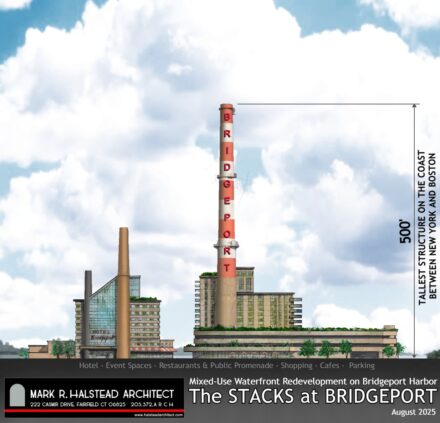
Architect Mark Halstead, board president of the Greater Bridgeport Symphony, has an idea to save The Stack at the retired power plant undergoing demolition in the South End for redevelopment.
From Halstead’s Facebook page.
In 1962, NYC’s Penn Station was torn down. No one believed it would really happen. Many didn’t care at the time – it was old, obsolete, and not in line with New York of the Future. Later, when it was gone forever, they cared.
Penn Station was a symbol of the heyday of New York. From 1910 to 1962, when you got off a train in New York City, you had ARRIVED. It was so big, so grand – a palace. It was forever, right? How could it ever go away?
Well, it did. Sensitive city planners, like Robert Moses, said it was a dirty old relic, and lots of people believed him. The planners decided that a sleek new station, in line with the fast-moving times, would do the job better and cost less to maintain. There were protests – thoughtful, intelligent protests. Wisdom just had to prevail . . . didn’t it? It didn’t, and New York lost its grandest gateway for good.
Bridgeport has a Penn Station, and it’s about to disappear forever. It’s certainly not a Beaux-Arts masterpiece, but it’s a civic monument, nonetheless. Our Smokestack: it’s a symbol of the industrial past of Bridgeport. It’s a landmark that everyone knows, visible for miles – even from Long Island. It’s one of the tallest structures in Connecticut (okay, okay . . . there are three buildings in Hartford that are taller by 20-30′). It lets you know: Bridgeport is ahead! When you need to get your bearings, you can spot it on the horizon and know where downtown Bridgeport is. When you cross the bridge on I-95, it’s something like getting off a train at old Penn Station: you know you’ve arrived in Bridgeport.
Many think it’s just a dirty old relic. (And it is dirty, for now.) On the subject of its demolition, many will say, “So what?” – until the day it’s gone, and there’s no turning back.
Bridgeport was built on its industry. Its motto Industria crescimus means “We Thrive by Industry.”
Even our radio station, WICC, is named for this motto: Industrial Capital of Connecticut. Indeed, industry put Bridgeport on the map. Despite all the tough years, the lean years, when the industry disappeared, Bridgeport remained the largest city in Connecticut, and we have the tallest structure in the State to proclaim it. (Okay, okay . . . three office buildings in Hartford are taller by 20 or 30 feet.) Nothing will ever again be built in Bridgeport that is so tall and so visible, and we have it.
Why did New York lose Penn Station? Progress, they said. Or was it a lack of imagination?
Why did Bridgeport lose its old railroad station, the Curtis Mansion, the Harral-Wheeler Mansion, and countless other houses, churches and public buildings? Not progress. It’s lack of imagination.
Lack of imagination cries to us from the top of the Smokestack, 500 feet above the Harbor. Buildings speak to us, and this one is saying, “I’m a landmark! I’m tall and unique! I’m the last of my kind! I can be an asset to any future development – a trademark, a symbol, a beacon.” Is anyone listening?The great architect Louis Kahn famously said, “A brick wants to be something. It aspires. Even a common, ordinary brick wants to be something more than it is.” Our Smokestack is something, and it aspires to be even more.
It amazes me that in so many other cities, developers seize upon iconic pieces of construction and integrate them into the fabric of new developments, yet in Bridgeport the first response, too often, is, “Get rid of that thing.” Our Smokestack can be the centerpiece of a great downtown development. All it takes is imagination.
Imagine hearing, “Where do you live?” “At the Stack!”
“Where should we eat tonight?” “There’s a great restaurant at The Stack!”
The Smokestack is attached to two existing steel structures about 9 and 14 stories high, that are designed for heavy industrial loads. These structures could be reused in cool, exciting ways for condominiums, retail, hotel or any other use that could bring life and business to downtown.
Imagine arriving on the Port Jeff Ferry and watching the Smokestack grow on the horizon, perhaps tricked out with creative lighting effects and dressed to go out on the town. Wouldn’t you want to get closer? Wouldn’t you want to experience it, maybe live alongside it? If surrounded by vibrant new development, it could be the premiere destination in Bridgeport. It could be. Imagine that.
Let’s talk Green Construction and the concept of Embodied Energy. Part One: in order to tear down the Smokestack and any of its attached structures, every part of it has to be cleaned, abated, and made environmentally safe. Then it has to be demolished and broken down by fossil-fueled machinery. It has to be carted miles away by diesel trucks and disposed of. Some of it will be recycled, but the better part of it will end up being buried in far-off landfills by diesel-fueled equipment.
Oh, but that’s not the end of the environmental cost of tearing down the Smokestack and its attachments. Part Two: whatever is built on the site has to be constructed of new materials that will be produced in factories far from Bridgeport and shipped here. Much steel used in U.S. construction today comes from overseas. The new materials will be delivered by hundreds of those fossil-fueled 18-wheelers and assembled on site.
Part Two is not necessary if existing structural elements are re-used. What’s that expression? “Reduce, Reuse, Recycle?”
The clean-up in Part One is required whether the buildings are torn down or reused. It’s a huge part of the development cost, which can either end up in a landfill, or become part of something spectacular.
“Embodied Energy” is the real cost of recreating materials in existing buildings. A central tenet of Green Building (often overlooked) is that the most environmentally responsible buildings are those that already exist. Every structure is capable of reuse and repurposing, without being trashed. The amount of Embodied Energy on the old U.I. site is impressive; it’s just waiting to be reused. The environmental cost of tearing down these sound structures and replacing them on this scale is staggering.
Does retaining our Smokestack involve expensive structural and cosmetic work? Indeed it does. Would it be worth it? I daresay most people would say Yes, or they will when the old Stack is gone. It will be missed literally by millions who know it, who use it as a navigational landmark. Even Eduardo Leandro, the new Conductor of the Greater Bridgeport Symphony who often flies his plane into Sikorsky airport, looks for our Smokestack when on VFR approach to Bridgeport.
Someday soon, maybe this October, we’ll all be in a Big Yellow Taxi, cruising up 95 out of Westport or Milford, or down Route 8 out of Shelton, and up ahead . . . the Smokestack is gone! As Joni Mitchell said, “You don’t know what you’ve got ‘til it’s gone.” How many times will Bridgeport make the mistake of paving paradise to put up a parking lot?Those of us who have been deeply involved in preservation efforts in Bridgeport have too often heard, “Too bad, but what are you going to do?” Many of us have gotten burned out watching treasures fall to the wrecking ball, one after another. We’ve lost landmarks, and we lament them when we drive by the empty lots or commonplace replacement buildings where historic structures once stood. Our Smokestack can be seen from hundreds of places, and if we just sit by and let it return to dust, our lament will be felt from all points of the compass around Bridgeport.
What can be done? Say something! Write something! Scream something! Let’s get our voices together and be heard. The Smokestack is still standing, so there’s still time. Where there’s life, there’s hope.
I’m not afraid of tilting at windmills, and I know I’m not alone.
Bridgeport has made some great strides in the last decade or so. Who would have imagined, back in the 1990s, people walking their dogs at midnight on Broad Street, or seeing the Foo Fighters at the Amphitheater?
Imagine: the Smokestack could literally be the symbol of Bridgeport finally rising out of the ashes, rising far into the sky. It’s a talisman of our industrial past that could be a sign to all, “every inch a proud and soaring thing,” a bright clean declaration of the future of Bridgeport-by-the-Sea. By Industry We Thrived, and by Imagination We Will Prosper.

How many reams, how high is this ‘soil bad” analyst going to be? Pricks 🤣
https://www.youtube.com/watch?v=6yrANUy_Wj8